
Last Updated: November 4, 2026
Quick Summary
Factory direct metal fabrication pricing removes the middleman, so you pay the shop that actually cuts, bends, and welds the metal instead of layers of resale. Broker markup hides inside inflated material rates, padded freight, and vague handling fees rather than appearing as a labeled line item. Buying direct gives you visibility into material and labor costs plus a single point of accountability.
- Sheet metal fabrication pricing comes down to material, machine time, and labor, in roughly that order.
- Setup, tooling, and programming are fixed costs that do not change with quantity.
- Demand line items for material, cutting, bending, welding, finishing, setup, and freight to compare quotes.
- Ask each supplier for a quantity break table at 1, 10, 50, 100, and 500 units.
- Confirm the shop owns its equipment by requesting an equipment list with capacities.
Table of Contents
- Why Factory-Direct Metal Fabrication Pricing Changes the Math
- What Drives Sheet Metal Fabrication Pricing
- How to Build a Custom Metal Fabrication Cost Estimate
- Metal Fabrication Quote Comparison: Line by Line
- How to Reduce Metal Fabrication Costs Without Cutting Quality
- How to Verify a Factory-Direct Supplier Before You Sign
- Request Your Factory-Direct Fabrication Quote
- Frequently Asked Questions
Why Factory-Direct Metal Fabrication Pricing Changes the Math
Factory direct metal fabrication pricing removes the middleman from the supply chain, and that single change can reshape a project budget. This guide explains how the model works, what drives cost, and how to compare quotes line by line.
When you buy from the shop that actually cuts, bends, and welds the metal, you pay for work, not for layers of resale. To see the concrete benefits of buying factory-direct, review factory direct railing pricing benefits. Below, we break down the numbers behind that difference.
What Factory-Direct Actually Means
Factory-direct means you buy from the fabricator that owns the equipment and employs the people doing the work. No broker sits between you and the shop.
This changes three things: direct access to the people who can answer technical questions, visibility into material and labor costs, and a single point of accountability for the finished part.
Where Broker Markup Hides in a Standard Quote
Broker markup rarely appears as a line item labeled “markup.” It hides inside inflated material rates, padded freight charges, and vague “handling” fees.
The tell is a quote with few line items and a large lump sum. If you cannot see material cost, machine time, and finishing separately, you cannot verify what you are paying for. For a deeper breakdown, see factory direct railing prices explained.
What Drives Sheet Metal Fabrication Pricing
Sheet metal fabrication pricing comes down to material, machine time, and labor, in roughly that order. Every quote is a sum of these inputs plus setup and margin.
Material Type, Grade, and Thickness
Material type is the first cost driver. Material type is the first cost driver, and cost varies with grade and market conditions.
Thickness drives cost two ways: thicker sheet uses more raw material and demands more machine force to cut and bend. A part in heavier gauge always costs more than the same geometry in lighter gauge.
Labor, Machine Time, and Shop Rates
Labor and machine time are billed together as an hourly shop rate covering the operator, the machine, and overhead. Laser cutting, CNC cutting, bending on a press brake, welding, machining, threading, and countersinking all consume machine time.
Compare total price, not rate alone.
How to Build a Custom Metal Fabrication Cost Estimate
A custom metal fabrication cost estimate is a bottom-up calculation: material plus machine time plus labor plus setup plus finishing plus margin. Build it in that order and you will spot an inflated quote quickly.
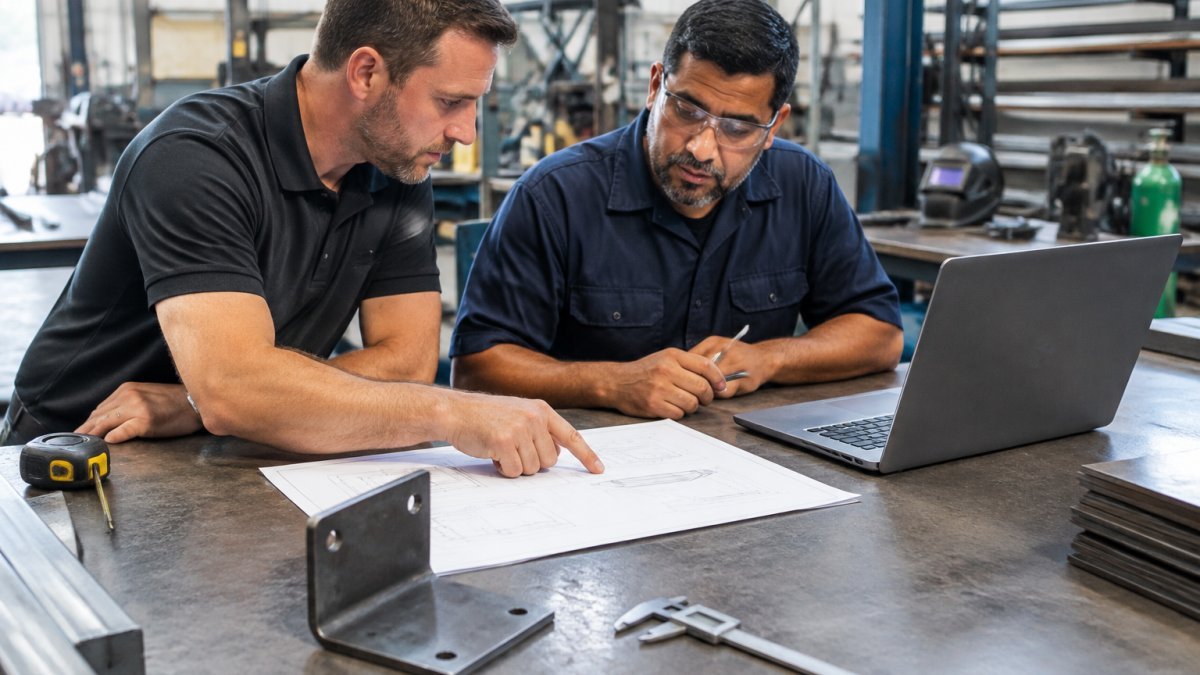
Start with material: calculate the sheet area the part needs, add a waste allowance, and multiply by the current price per unit area. Then estimate machine time for each operation.
Setup, Tooling, and Programming Costs
Setup, tooling, and programming are fixed costs that do not change with quantity. Programming the cutting path, setting up the press brake, and preparing tooling take time before the first part is made.
This is why a single prototype carries a high unit price: setup is spread across one unit. On a run of hundreds, the same setup is divided across every piece. For budgeting guidance, use how to budget custom metal railings.
Order Quantity, Prototypes, and Economies of Scale
Order quantity is the lever with the most use on unit price. Economies of scale come from spreading fixed costs and improving material use across a longer run.
A prototype is priced for learning, not savings. Approve the design on the prototype, then move to a production run to capture the price break. Ask your supplier for a quantity break table.
| Cost Driver | What It Covers | Effect on Unit Price |
|---|---|---|
| Material type and grade | Raw material cost | Higher grade raises price |
| Thickness | Material volume and machine force | Thicker sheet costs more |
| Machine time | Cutting, bending, welding | More operations raise price |
| Setup and programming | Fixed prep per order | Falls sharply with volume |
| Order quantity | Economies of scale | Larger runs lower unit price |
| Finishing | Powder coating, surface finishing | Adds a per-part charge |
Metal Fabrication Quote Comparison: Line by Line
Metal fabrication quote comparison only works when every quote is itemized the same way. Demand line items for material, cutting, bending, welding, finishing, setup, and freight.
Match line to line. A lower total built on a thinner gauge or cheaper finish is not a better deal, it is a different part.
A Transparent, Itemized Sample Quote
Here is the structure a legitimate itemized quote should follow. The structure below shows the format of a legitimate itemized quote and how each line behaves across quantities:
| Line Item | Basis | Quantity 1 | Quantity 50 | Quantity 500 |
|---|---|---|---|---|
| Raw material | Sheet area × price per square foot, plus 10-15% waste allowance | $18.00 | $16.50 | $15.75 |
| Cutting | Laser time per part | $12.00 | $9.50 | $8.00 |
| Bending | Number of bends × cost per bend | $9.00 | $7.00 | $5.50 |
| Welding and machining | Operations and time | $22.00 | $18.00 | $15.00 |
| Surface finishing | Powder coating per part | $14.00 | $11.00 | $9.50 |
| Setup and programming | One-time charge per order | $150.00 | $150.00 | $150.00 |
| Inspection | Per lot or per part, depending on plan | $0.00 | $2.00 | $1.50 |
| Packaging | Per carton or per pallet | $3.00 | $2.50 | $2.00 |
| Freight | Terms and delivery estimate | $45.00 | $120.00 | $650.00 |
| Unit price | Sum of lines above divided by quantity | $273.00 | $216.50 | $207.25 |
Setup charges are spread across the order quantity, which is why a prototype and a production run of the same part can carry very different unit prices.
Watch out: a quote that shows only a total, or bundles material and cutting into one “fabrication” line, cannot be compared against an itemized quote.
How to Compare Quotes Without Getting Fooled
Build a comparison sheet with one column per supplier and one row per line item from the table above. Then apply three checks:
- Normalize the scope. Confirm every quote covers the same material grade, thickness, finish, tolerance, and quantity. A quote missing the finishing line is not cheaper; it is incomplete.
- Separate fixed from variable costs. Setup, programming, and tooling are fixed per order. Material, cutting, bending, welding, and finishing are variable per part.
- Test the price breaks. Ask each supplier for a quantity break table at 1, 10, 50, 100, and 500 units. Plot the unit price against quantity. The supplier whose curve flattens earliest is usually the one with the most efficient setup and material use.
The lowest quote at one quantity is not always the lowest at another. Comparing only the headline number at one quantity hides that reversal.
To see what a legitimate itemized estimate should contain so you can compare quotes fairly, review what a free railing estimate should include.
Total Landed Cost and Sourcing Risk
Total landed cost is the quote price plus freight, duties, inspection, and the cost of delay. A low unit price from a distant supplier can lose its advantage once shipping and risk are added.
Sourcing risk includes lead time slippage, quality failures, and rework cost. Ask for lead time in writing and confirm who pays for freight. Weigh total landed cost, not the headline unit price.
Add these lines to your comparison sheet: freight to your dock, duties or tariffs, insurance, payment processing fees, incoming inspection time, and an allowance for rework if the first article fails. Two quotes a few dollars apart per unit can flip once those lines are included.
How to Reduce Metal Fabrication Costs Without Cutting Quality
Reducing metal fabrication costs starts with design, not with squeezing your supplier. Design for manufacturability, sensible tolerances, and smart quantity planning cut cost without weakening the part.
A common mistake is over-specifying tolerance. Tighter precision costs more machine time. Specify only the tolerance the part actually needs.
Design for Manufacturability and Tolerance Choices
Design for manufacturability means shaping the part so it is efficient to cut, bend, and weld. Fewer bends, simpler geometry, and standard material sizes all lower cost.
Watch out: a mirror finish or a tolerance tighter than the application requires can quietly multiply your price. Match finish and tolerance to how the part is used.
How to Verify a Factory-Direct Supplier Before You Sign
Verifying a factory-direct supplier means confirming the shop actually owns the equipment and does the work. Ask for a shop tour, request equipment details, and confirm which operations happen in-house versus outsourced.
Ask who is responsible for materials, fabrication, and installation, and get it in writing.
A Five-Step Verification Workflow
Most buyers stop at “do you have a laser?” and accept a yes. That answer does not distinguish a fabricator from a reseller. Use this sequence instead:
- Confirm facility ownership and address. Ask for the legal entity name, the physical address of the shop, and a business license or registration that matches. Cross-check the address and entity against public business records.
- Request an equipment list with capacities. Ask for make, model, and capacity of the cutting, bending, welding, and finishing equipment. A fabricator can name specific machines and their tonnage, bed size, and power. A broker typically replies with a generic capability statement.
- Map each operation to a location. For every line on your quote, cutting, bending, welding, finishing, inspection, ask whether it happens in-house or is subcontracted. Subcontracted finishing is common and acceptable, but you need to know, because it adds a handoff, a lead-time buffer, and a second party who can cause a defect.
- Ask for a first article inspection plan. Confirm how the first part will be measured against the drawing, what tolerances will be checked, and who signs the inspection report. A supplier who cannot describe an inspection plan is not set up to catch defects before shipment.
- Put accountability in the contract. Name who is responsible for material certification, dimensional conformity, finish adhesion, packaging, and freight damage. State the remedy for nonconforming parts, rework, replacement, or credit, and the lead time for each.
Watch out: a supplier who will not provide a physical address, an equipment list, or an inspection plan before you sign is a sourcing risk regardless of price. The lowest quote from an unverifiable supplier is the most expensive quote you can accept.
Documents to Request Before You Sign
Ask for these documents and read them, not just collect them:
- Material certifications. Mill certs or test reports that tie the heat number to the grade and chemistry specified on your drawing.
- Quality system evidence. A current certificate or a documented inspection procedure, depending on the supplier’s size and the criticality of your part.
- Insurance certificate. General liability and, where applicable, product liability coverage, with you named as additional insured for the project.
- Sample inspection report. A completed first article inspection report from a prior job, redacted if needed, so you can see the format and the level of detail.
- Reference projects. Two or three comparable jobs with contact information, so you can ask about on-time delivery and rework rates.
Inspection is not free: a first article inspection, in-process checks, and a final dimensional report each consume labor. Ask for inspection as a separate line so you can see what you are buying.
Red Flags That Signal an Intermediary
A few patterns reliably separate a broker from a fabricator. The quote arrives fast but the technical questions come back slowly, because the broker has to forward them. The lead time is quoted in round weeks with no explanation of queue or material procurement. The supplier cannot tell you the current price of the sheet grade you specified or the mill it comes from. And the quote has no setup line, because the broker does not know what the shop’s setup actually costs.
None of these alone proves an intermediary, but two or more together should trigger the verification steps above before you send a deposit.
Request Your Factory-Direct Fabrication Quote
The gap between a marked-up quote and a factory-direct one comes down to visibility. When material, machine time, labor, and setup are broken out, you can compare fairly and stop paying for layers you never needed.
Quality Railings Miami offers custom architectural metalwork and glass systems for residential, commercial, and high-rise projects across South Florida. Ready to see the difference on your own numbers? Contact us to request your factory-direct quote.
Frequently Asked Questions
How much do metal fabricators charge?
Fabricators bill through a mix of material, machine time, labor hours, and setup, so there is no single rate. In practice, a quote is built from the raw material weight and grade, cutting and bending time at an hourly shop rate, welding and finishing hours, plus a one-time setup and programming charge. Ask for those lines separately. When a supplier quotes only a lump sum, you cannot tell whether the saving comes from material, labor, or a thinner gauge, and metal fabrication pricing becomes impossible to compare.
Does factory-direct metal fabrication cost less than going through a broker?
It usually can, because a broker adds a markup on top of the same shop’s work without adding capacity. The saving is real only when you can see the itemized breakdown. Ask for material type and thickness, machine time, labor hours, finishing, and any setup or tooling charge on separate lines. Then compare that structure against your current supplier’s quote. If your existing quote already shows those lines at competitive rates, factory-direct metal fabrication pricing may not beat it, and you should say so rather than assume.
What information should I provide to get an accurate fabrication quote?
Send dimensioned drawings or CAD files, the material type and grade, thickness, required tolerance, surface finish, quantity, and the deadline. Note any welding, threading, countersinking, or powder coating. State the project address if the work must meet local code, since that affects engineering review. A complete RFQ shortens the quote cycle and reduces revisions. Incomplete packages are the most common reason a metal fabrication quote comparison stalls, because each shop prices a different assumption.
How can I compare metal fabrication quotes fairly?
Normalize every quote to the same scope before you compare totals. Check that each one uses the same material grade and thickness, the same tolerance, the same finish, and the same quantity, including whether setup is charged once or per unit. Then compare the line items: cost per bend, hourly rate, material utilization, and lead time. A lower total often hides a thinner gauge or a skipped finishing step. Request a sample itemized quote structure from each supplier so the comparison is apples to apples.
The real test is your next RFQ. Send it to a factory-direct fabricator and a broker, then compare the line items side by side. Get started with Quality Railings Miami and put factory-direct pricing to work on your project.
